
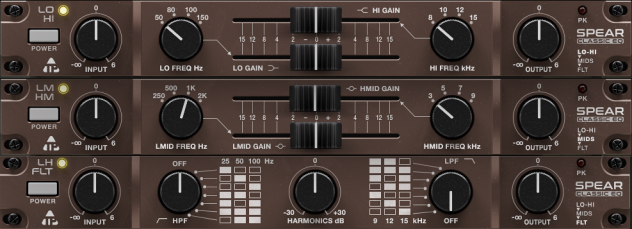
A Classic Passive 4 band eq
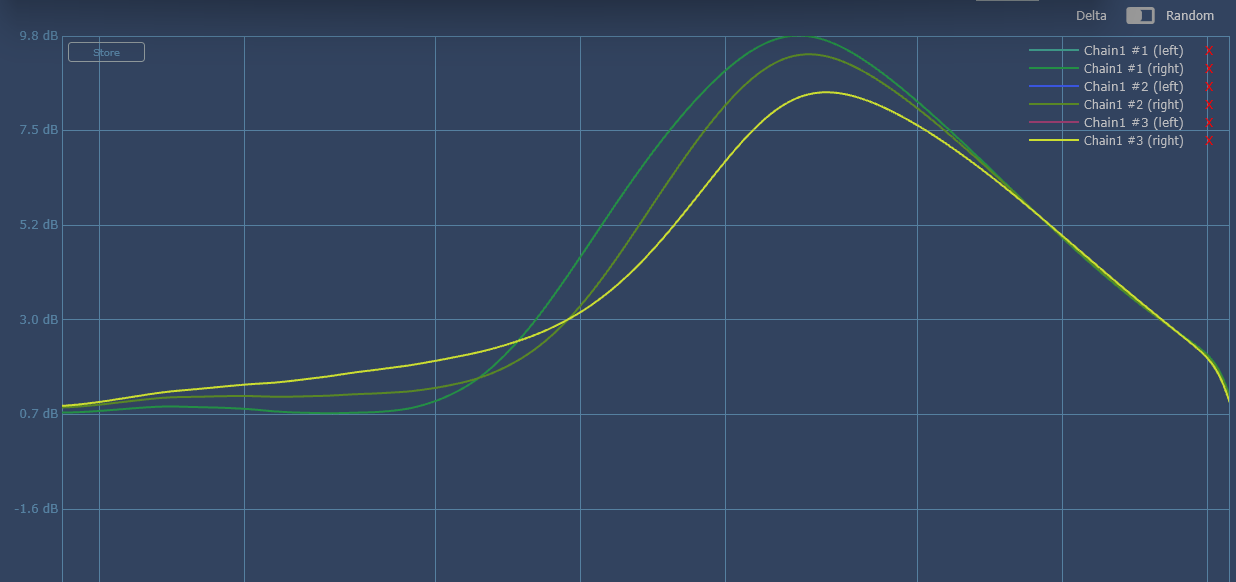
This EQ is widely celebrated for its unique eq shapes. This is in fact, because the mid bands in particular interact so heavily, Notably the mid range has the most extreme interaction. Because of this it was essential those bands are sampled together to capture the hardware’s true accuracy. This interaction directly shapes the resulting curves, frequently producing unique, asymmetrical slopes. For instance, even leaving the low-mid band at unity gain does not isolate it fully from the high band in circuit; its selected frequency will interactively warp the curve shape of an active high-mid band, giving a asymmetrical shapes. The Low and high shelfs also have this type of artifact to a lesser degree. This of course is part of the eq’s unique sound.
Figure A example: High mid 10db/3k and Low mid 0db set. Each stored shape is moving the low mid selection.
A
Spec-
Low Shelving Band:Gain: ±15 dB Frequencies: 50 Hz, 80 Hz, 100 Hz, and 150 Hz
Low-Mid Peaking (Bell) Band:Gain: ±15 dB Frequencies: 250 Hz, 500 Hz, 1 kHz, and 2 kHz
High-Mid Peaking (Bell) Band:Gain: ±15 dB Frequencies: 3 kHz, 5 kHz, 7 kHz, and 9 kHz
High Shelving Band:Gain: ±15 dB Frequencies: 8 kHz, 10 kHz, 12 kHz, and 15 kHz
High-Pass Filter (HPF): Switchable points at 25 Hz, 50 Hz, and 100 Hz
Low-Pass Filter (LPF): Switchable points at 9 kHz, 12 kHz, and 15 kHz
In Practice–
Order of instances should be Low/High Shelf>Mid band>Filters (harmonics stage)
Filters instance note: I’ve given every selectable button combination over two knobs to keep cpu low. By combining two or three button selections results in different slopes and frequencies.